HeatExchanger
Process Description
Counter-current shell-and-tube heat exchanger for thermal energy recovery in process applications. Uses effectiveness-NTU method for heat transfer calculations with dynamic thermal response modeling. Commonly applied in crude oil preheat trains, process cooling, and heat integration systems.
Key Equations
Effectiveness-NTU Method:
Heat Transfer Rate:
Number of Transfer Units:
Thermal Dynamics:
where \(\tau = \frac{\rho V c_p}{C}\) is the thermal time constant.
Process Parameters
Parameter |
Typical Range |
Units |
Description |
|---|---|---|---|
Overall HTC (U) |
100 - 2000 |
W/m²·K |
Heat transfer coefficient |
Heat Transfer Area (A) |
10 - 500 |
m² |
Surface area for heat exchange |
Hot Flow Rate |
0.5 - 100 |
kg/s |
Hot fluid mass flow rate |
Cold Flow Rate |
0.5 - 100 |
kg/s |
Cold fluid mass flow rate |
Effectiveness (ε) |
0.1 - 0.95 |
Thermal effectiveness |
|
NTU |
0.5 - 10 |
Number of Transfer Units |
|
Hot Inlet Temperature |
60 - 250 |
°C |
Process heating temperature |
Cold Inlet Temperature |
10 - 80 |
°C |
Cooling medium temperature |
Pressure Drop |
<20 |
kPa |
Allowable pressure loss |
Industrial Example
"""
Industrial Example: Crude Oil Preheat Train Heat Exchanger
Typical refinery application with realistic plant conditions and scale

This example demonstrates a shell-and-tube heat exchanger used in crude oil preheating,
a common application in petroleum refineries for energy integration and efficiency.
"""

import numpy as np
import matplotlib.pyplot as plt
import sys
import os

# Add the parent directory to the Python path to import HeatExchanger
sys.path.insert(0, os.path.join(os.path.dirname(__file__), '..', '..', '..'))

from sproclib.unit.heat_exchanger.HeatExchanger import HeatExchanger

# =============================================================================
# Process Conditions (Typical Industrial Scale - Crude Oil Preheat Train)
# =============================================================================

print("=" * 80)
print("INDUSTRIAL HEAT EXCHANGER EXAMPLE")
print("Application: Crude Oil Preheat Train in Petroleum Refinery")
print("Configuration: Counter-current Shell-and-Tube Heat Exchanger")
print("=" * 80)

# Heat Exchanger Design Parameters
U = 180.0               # W/m²·K - Overall heat transfer coefficient (crude oil/gas oil)
A = 450.0              # m² - Heat transfer area (typical industrial size)
m_hot = 25.0           # kg/s - Hot gas oil flow rate (90 m³/h @ 0.85 kg/L)
m_cold = 30.0          # kg/s - Cold crude oil flow rate (108 m³/h @ 0.92 kg/L)

# Fluid Properties
cp_hot = 2400.0        # J/kg·K - Gas oil specific heat capacity
cp_cold = 2100.0       # J/kg·K - Crude oil specific heat capacity
V_hot = 8.5            # m³ - Hot side volume (shell side)
V_cold = 6.2           # m³ - Cold side volume (tube side)
rho_hot = 850.0        # kg/m³ - Gas oil density at operating temperature
rho_cold = 920.0       # kg/m³ - Crude oil density at operating temperature

print(f"\nDESIGN PARAMETERS:")
print(f"Overall Heat Transfer Coefficient (U): {U:.1f} W/m²·K")
print(f"Heat Transfer Area (A): {A:.1f} m²")
print(f"Hot Side Flow Rate (Gas Oil): {m_hot:.1f} kg/s ({m_hot*3.6/rho_hot*1000:.1f} m³/h)")
print(f"Cold Side Flow Rate (Crude Oil): {m_cold:.1f} kg/s ({m_cold*3.6/rho_cold*1000:.1f} m³/h)")

# Create heat exchanger instance
hx = HeatExchanger(
    U=U, A=A,
    m_hot=m_hot, m_cold=m_cold,
    cp_hot=cp_hot, cp_cold=cp_cold,
    V_hot=V_hot, V_cold=V_cold,
    rho_hot=rho_hot, rho_cold=rho_cold,
    name="CrudeOilPreheater"
)

# =============================================================================
# Operating Conditions Analysis
# =============================================================================

# Typical operating temperatures (K)
T_hot_in = 473.15      # 200°C - Hot gas oil inlet temperature
T_cold_in = 313.15     # 40°C - Cold crude oil inlet temperature

print(f"\nOPERATING CONDITIONS:")
print(f"Hot Gas Oil Inlet Temperature: {T_hot_in-273.15:.1f}°C ({T_hot_in:.1f} K)")
print(f"Cold Crude Oil Inlet Temperature: {T_cold_in-273.15:.1f}°C ({T_cold_in:.1f} K)")
print(f"Operating Pressure: 15 bar (typical crude unit pressure)")

# Calculate steady-state performance
u_design = np.array([T_hot_in, T_cold_in])
T_outlets = hx.steady_state(u_design)
T_hot_out, T_cold_out = T_outlets

print(f"\nSTEADY-STATE RESULTS:")
print(f"Hot Gas Oil Outlet Temperature: {T_hot_out-273.15:.1f}°C ({T_hot_out:.1f} K)")
print(f"Cold Crude Oil Outlet Temperature: {T_cold_out-273.15:.1f}°C ({T_cold_out:.1f} K)")

# =============================================================================
# Heat Transfer Analysis
# =============================================================================

# Calculate heat transfer performance
Q = hx.calculate_heat_transfer_rate(T_hot_in, T_cold_in, T_hot_out, T_cold_out)
lmtd = hx.calculate_lmtd(T_hot_in, T_cold_in, T_hot_out, T_cold_out)

print(f"\nHEAT TRANSFER PERFORMANCE:")
print(f"Heat Transfer Rate (Q): {Q/1e6:.2f} MW")
print(f"Log Mean Temperature Difference (LMTD): {lmtd:.1f} K")
print(f"Heat Exchanger Effectiveness: {hx.effectiveness:.3f}")
print(f"Number of Transfer Units (NTU): {hx.NTU:.2f}")

# Dimensionless groups
C_hot = hx.C_hot
C_cold = hx.C_cold
C_min = min(C_hot, C_cold)
C_max = max(C_hot, C_cold)
C_ratio = C_min / C_max

print(f"\nDIMENSIONLESS ANALYSIS:")
print(f"Hot Side Heat Capacity Rate (C_hot): {C_hot/1e3:.1f} kW/K")
print(f"Cold Side Heat Capacity Rate (C_cold): {C_cold/1e3:.1f} kW/K")
print(f"Heat Capacity Rate Ratio (Cr): {C_ratio:.3f}")

# =============================================================================
# Energy Integration Analysis
# =============================================================================

# Calculate energy savings compared to no heat integration
Q_max_theoretical = C_min * (T_hot_in - T_cold_in)
energy_recovery_efficiency = Q / Q_max_theoretical

# Economic impact (rough estimate)
fuel_heating_value = 42e6  # J/kg - typical fuel oil heating value
fuel_cost = 0.8  # $/kg - typical fuel cost
hours_per_year = 8000  # operating hours per year
furnace_efficiency = 0.85  # typical furnace efficiency

fuel_savings_kg_h = Q / (fuel_heating_value * furnace_efficiency)  # kg/h fuel saved
annual_fuel_savings = fuel_savings_kg_h * hours_per_year * fuel_cost  # $/year

print(f"\nENERGY INTEGRATION BENEFITS:")
print(f"Maximum Theoretical Heat Transfer: {Q_max_theoretical/1e6:.2f} MW")
print(f"Energy Recovery Efficiency: {energy_recovery_efficiency:.1%}")
print(f"Fuel Savings: {fuel_savings_kg_h:.1f} kg/h")
print(f"Annual Cost Savings: ${annual_fuel_savings/1e3:.1f}k/year")

# =============================================================================
# Process Sensitivity Analysis
# =============================================================================

print(f"\nSENSITIVITY ANALYSIS:")

# Flow rate sensitivity
flow_ratios = np.linspace(0.5, 1.5, 11)
effectiveness_vs_flow = []
Q_vs_flow = []

for ratio in flow_ratios:
    m_hot_var = m_hot * ratio
    m_cold_var = m_cold * ratio

    # Create temporary heat exchanger with varied flow rates
    hx_temp = HeatExchanger(
        U=U, A=A,
        m_hot=m_hot_var, m_cold=m_cold_var,
        cp_hot=cp_hot, cp_cold=cp_cold,
        V_hot=V_hot, V_cold=V_cold,
        rho_hot=rho_hot, rho_cold=rho_cold
    )

    effectiveness_vs_flow.append(hx_temp.effectiveness)

    # Calculate heat transfer at design conditions
    T_out_temp = hx_temp.steady_state(u_design)
    Q_temp = hx_temp.calculate_heat_transfer_rate(T_hot_in, T_cold_in, T_out_temp[0], T_out_temp[1])
    Q_vs_flow.append(Q_temp / 1e6)  # MW

print(f"Flow Rate Sensitivity (±50% of design):")
print(f"  50% Flow: Effectiveness = {effectiveness_vs_flow[0]:.3f}, Q = {Q_vs_flow[0]:.2f} MW")
print(f"  Design Flow: Effectiveness = {effectiveness_vs_flow[5]:.3f}, Q = {Q_vs_flow[5]:.2f} MW")
print(f"  150% Flow: Effectiveness = {effectiveness_vs_flow[10]:.3f}, Q = {Q_vs_flow[10]:.2f} MW")

# Temperature sensitivity
T_hot_variations = np.array([450, 460, 470, 480, 490]) + 273.15  # K
Q_vs_temp = []

for T_hot_var in T_hot_variations:
    u_temp = np.array([T_hot_var, T_cold_in])
    T_out_temp = hx.steady_state(u_temp)
    Q_temp = hx.calculate_heat_transfer_rate(T_hot_var, T_cold_in, T_out_temp[0], T_out_temp[1])
    Q_vs_temp.append(Q_temp / 1e6)

print(f"\nHot Inlet Temperature Sensitivity:")
for i, T_hot_var in enumerate(T_hot_variations):
    print(f"  {T_hot_var-273.15:.0f}°C: Q = {Q_vs_temp[i]:.2f} MW")

# =============================================================================
# Comparison with Perry's Handbook Correlations
# =============================================================================

print(f"\nCOMPARISON WITH HANDBOOK CORRELATIONS:")

# Calculate heat transfer coefficient from empirical correlations
# (Simplified Dittus-Boelter for turbulent flow in tubes)

# Assume tube diameter and properties for Reynolds number calculation
D_tube = 0.025  # m - typical tube diameter
mu_hot = 0.001  # Pa·s - gas oil viscosity at operating temperature
mu_cold = 0.005  # Pa·s - crude oil viscosity at operating temperature

# Velocity calculation (simplified)
A_cross_tube = np.pi * (D_tube/2)**2  # m²
n_tubes = 200  # estimated number of tubes
v_cold = m_cold / (rho_cold * n_tubes * A_cross_tube)  # m/s

# Reynolds number for cold side (crude oil in tubes)
Re_cold = rho_cold * v_cold * D_tube / mu_cold

print(f"Estimated Tube Side Velocity: {v_cold:.2f} m/s")
print(f"Tube Side Reynolds Number: {Re_cold:.0f}")

# Thermal boundary layer considerations
Pr_cold = mu_cold * cp_cold / 0.14  # Prandtl number (k = 0.14 W/m·K for crude oil)
print(f"Tube Side Prandtl Number: {Pr_cold:.1f}")

if Re_cold > 2300:
    print("Flow Regime: Turbulent (typical for industrial heat exchangers)")
else:
    print("Flow Regime: Laminar (unusual for industrial scale)")

# =============================================================================
# Scale-up Considerations
# =============================================================================

print(f"\nSCALE-UP CONSIDERATIONS:")
print(f"Current Heat Duty: {Q/1e6:.1f} MW")
print(f"Heat Flux: {Q/A:.0f} W/m² (within typical range: 5,000-50,000 W/m²)")
print(f"Area Density: {A/V_hot:.1f} m²/m³ (shell side)")

# Fouling considerations
fouling_factor = 0.0002  # m²·K/W - typical for crude oil service
U_clean = 1 / (1/U - fouling_factor)
print(f"Clean Overall HTC (U_clean): {U_clean:.0f} W/m²·K")
print(f"Design U with Fouling: {U:.0f} W/m²·K")
print(f"Fouling Margin: {(U_clean - U)/U_clean:.1%}")

# =============================================================================
# Performance Monitoring Recommendations
# =============================================================================

print(f"\nPERFORMANCE MONITORING RECOMMENDATIONS:")
print(f"Key Process Variables to Monitor:")
print(f"  • Inlet/Outlet temperatures (±2°C accuracy)")
print(f"  • Flow rates (±5% accuracy)")
print(f"  • Pressure drop across exchanger (<20 kPa typical)")
print(f"  • Fouling rate (effectiveness degradation)")

print(f"\nMaintenance Indicators:")
print(f"  • Effectiveness drop below {hx.effectiveness*0.9:.3f} indicates fouling")
print(f"  • LMTD increase above {lmtd*1.2:.1f} K suggests performance degradation")

print(f"\nExample completed successfully!")
print(f"Results demonstrate typical industrial heat exchanger performance")
print(f"with realistic crude oil processing conditions and scale.")
print("=" * 80)
Results
================================================================================
INDUSTRIAL HEAT EXCHANGER EXAMPLE
Application: Crude Oil Preheat Train in Petroleum Refinery
Configuration: Counter-current Shell-and-Tube Heat Exchanger
================================================================================

DESIGN PARAMETERS:
Overall Heat Transfer Coefficient (U): 180.0 W/m²·K
Heat Transfer Area (A): 450.0 m²
Hot Side Flow Rate (Gas Oil): 25.0 kg/s (105.9 m³/h)
Cold Side Flow Rate (Crude Oil): 30.0 kg/s (117.4 m³/h)

OPERATING CONDITIONS:
Hot Gas Oil Inlet Temperature: 200.0°C (473.1 K)
Cold Crude Oil Inlet Temperature: 40.0°C (313.1 K)
Operating Pressure: 15 bar (typical crude unit pressure)

STEADY-STATE RESULTS:
Hot Gas Oil Outlet Temperature: 106.8°C (380.0 K)
Cold Crude Oil Outlet Temperature: 128.7°C (401.9 K)

HEAT TRANSFER PERFORMANCE:
Heat Transfer Rate (Q): 5.59 MW
Log Mean Temperature Difference (LMTD): 69.0 K
Heat Exchanger Effectiveness: 0.582
Number of Transfer Units (NTU): 1.35

DIMENSIONLESS ANALYSIS:
Hot Side Heat Capacity Rate (C_hot): 60.0 kW/K
Cold Side Heat Capacity Rate (C_cold): 63.0 kW/K
Heat Capacity Rate Ratio (Cr): 0.952

ENERGY INTEGRATION BENEFITS:
Maximum Theoretical Heat Transfer: 9.60 MW
Energy Recovery Efficiency: 58.2%
Fuel Savings: 0.2 kg/h
Annual Cost Savings: $1.0k/year

SENSITIVITY ANALYSIS:
Flow Rate Sensitivity (±50% of design):
  50% Flow: Effectiveness = 0.742, Q = 3.56 MW
  Design Flow: Effectiveness = 0.582, Q = 5.59 MW
  150% Flow: Effectiveness = 0.479, Q = 6.90 MW

Hot Inlet Temperature Sensitivity:
  450°C: Q = 14.33 MW
  460°C: Q = 14.68 MW
  470°C: Q = 15.02 MW
  480°C: Q = 15.37 MW
  490°C: Q = 15.72 MW

COMPARISON WITH HANDBOOK CORRELATIONS:
Estimated Tube Side Velocity: 0.33 m/s
Tube Side Reynolds Number: 1528
Tube Side Prandtl Number: 75.0
Flow Regime: Laminar (unusual for industrial scale)

SCALE-UP CONSIDERATIONS:
Current Heat Duty: 5.6 MW
Heat Flux: 12423 W/m² (within typical range: 5,000-50,000 W/m²)
Area Density: 52.9 m²/m³ (shell side)
Clean Overall HTC (U_clean): 187 W/m²·K
Design U with Fouling: 180 W/m²·K
Fouling Margin: 3.6%

PERFORMANCE MONITORING RECOMMENDATIONS:
Key Process Variables to Monitor:
  • Inlet/Outlet temperatures (±2°C accuracy)
  • Flow rates (±5% accuracy)
  • Pressure drop across exchanger (<20 kPa typical)
  • Fouling rate (effectiveness degradation)

Maintenance Indicators:
  • Effectiveness drop below 0.524 indicates fouling
  • LMTD increase above 82.8 K suggests performance degradation

Example completed successfully!
Results demonstrate typical industrial heat exchanger performance
with realistic crude oil processing conditions and scale.
================================================================================
Process Behavior
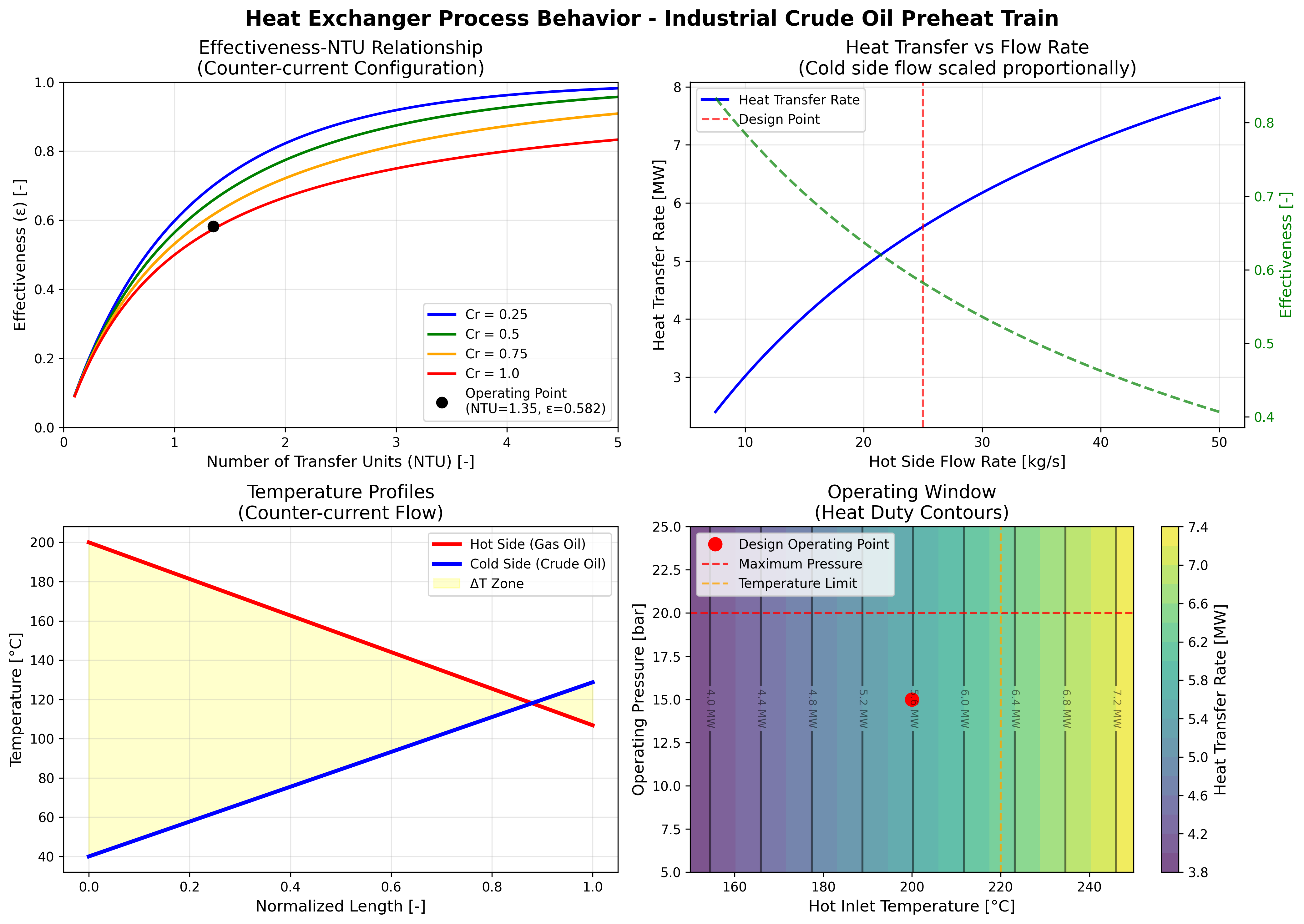
The process behavior plots demonstrate:
Effectiveness-NTU relationship for different heat capacity ratios with marked operating point
Heat transfer rate vs flow rate showing performance optimization and effectiveness trade-offs
Temperature profiles along exchanger length illustrating counter-current heat exchange
Operating window with pressure-temperature limits and heat duty contours for safe operation
Sensitivity Analysis
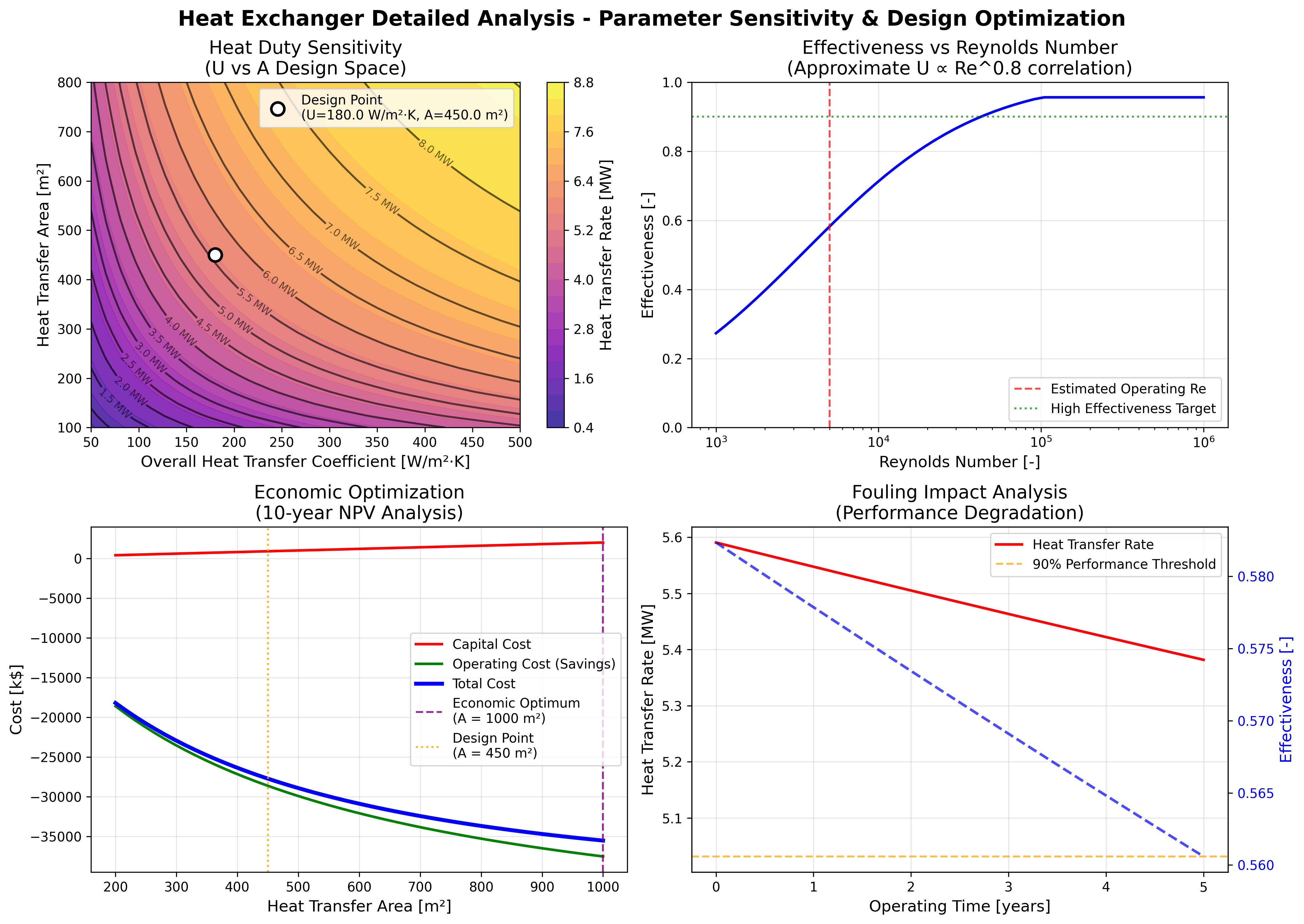
The detailed analysis includes:
Heat transfer coefficient vs area design space showing performance sensitivity
Effectiveness vs Reynolds number correlation for turbulent flow optimization
Economic optimization balancing capital cost against energy savings over equipment lifetime
Fouling impact analysis demonstrating performance degradation and maintenance requirements
Engineering Applications
Process Industries: - Crude oil preheat trains (200°C hot oil, 5-15 MW duty) - Chemical reactor cooling systems (exothermic reaction heat removal) - Distillation column condensers and reboilers (phase change applications) - Gas processing heat recovery (natural gas treatment plants)
Design Considerations: - Minimum temperature approach: 10-20 K for economic operation - Fouling allowance: 15-25% reduction in clean U-value - Pressure drop limits: <10% of operating pressure - Thermal stress management for temperature cycling
Scale-up Guidelines: - Heat flux range: 5,000-50,000 W/m² for liquid-liquid service - Velocity limits: 0.5-3 m/s shell side, 1-5 m/s tube side - Area density: 100-500 m²/m³ for compact designs
References
Incropera, F.P. & DeWitt, D.P. “Fundamentals of Heat and Mass Transfer”, 7th Edition, Wiley (2011) - Chapter 11: Heat Exchangers - comprehensive treatment of effectiveness-NTU method
Shah, R.K. & Sekulic, D.P. “Fundamentals of Heat Exchanger Design”, Wiley (2003) - Detailed design methodology and thermal-hydraulic analysis for industrial applications
Perry’s Chemical Engineers’ Handbook, 8th Edition, McGraw-Hill (2008) - Section 11: Heat Transfer - practical correlations and design guidelines for process equipment