PipeFlow Class
Overview
The PipeFlow class implements a comprehensive pipe flow transport model for steady-state and dynamic analysis of fluid flow through pipelines. This model is essential for process control applications involving fluid transport systems.
Class Description
The PipeFlow class provides accurate modeling of pressure drop, temperature effects, and flow characteristics in pipeline systems. It implements the Darcy-Weisbach equation for friction factor calculations and includes thermal dynamics for temperature-dependent applications.
Key Features
Pressure Drop Calculations: Accurate pressure drop prediction using Darcy-Weisbach equation
Reynolds Number Analysis: Automatic flow regime identification (laminar/turbulent)
Thermal Effects: Temperature-dependent fluid properties and heat transfer
Elevation Changes: Hydrostatic pressure effects for non-horizontal pipelines
Friction Factor Models: Multiple correlations for different pipe roughness conditions
Mathematical Model
The pipe flow model is based on fundamental fluid mechanics principles:
Pressure Drop Equation:
Where: - \(\Delta P\) = pressure drop (Pa) - \(f\) = Darcy friction factor (-) - \(L\) = pipe length (m) - \(D\) = pipe diameter (m) - \(\rho\) = fluid density (kg/m³) - \(v\) = flow velocity (m/s) - \(g\) = gravitational acceleration (9.81 m/s²) - \(\Delta h\) = elevation change (m)
Reynolds Number:
Where \(\mu\) is the dynamic viscosity (Pa·s).
Constructor Parameters
PipeFlow(
    pipe_length=1000.0,      # Pipeline length [m]
    pipe_diameter=0.2,       # Pipeline diameter [m]
    roughness=1e-4,          # Surface roughness [m]
    elevation_change=0.0,    # Elevation change [m]
    fluid_density=1000.0,    # Fluid density [kg/m³]
    fluid_viscosity=1e-3,    # Fluid viscosity [Pa·s]
    name="PipeFlow"
)
Methods
steady_state(u)
Calculate steady-state pressure and temperature for given flow conditions.
Input: u = [P_inlet, T_inlet, flow_rate]
Output: [P_outlet, T_outlet]
dynamics(t, x, u)
Calculate dynamic derivatives for time-domain analysis.
Input:
- t: time (s)
- x: state vector [P_outlet, T_outlet]
- u: input vector [P_inlet, T_inlet, flow_rate]
Output: [dP_outlet/dt, dT_outlet/dt]
describe()
Returns comprehensive metadata about the model including algorithms, parameters, and equations.
Usage Examples
Basic Pipeline Analysis
#!/usr/bin/env python3
"""
PipeFlow Example Usage - Comprehensive Demonstration

This example demonstrates the capabilities of the PipeFlow class for modeling
single-phase liquid flow in pipes. It covers both steady-state and dynamic
analysis with various scenarios and parameter studies.

Based on: PipeFlow_documentation.md
"""

import numpy as np
import matplotlib.pyplot as plt
import sys
import os

# Add the directory to Python path for imports
sys.path.append(os.path.dirname(os.path.abspath(__file__)))

try:
    from PipeFlow import PipeFlow
except ImportError:
    print("Error: Could not import PipeFlow. Make sure PipeFlow.py is in the current directory.")
    sys.exit(1)

def example_1_basic_pipe_flow():
    """
    Example 1: Basic pipe flow calculation for a water supply line

    Scenario: Water supply line from storage tank to treatment plant
    - 500m long pipeline
    - 15cm diameter steel pipe
    - Water at 20°C
    """
    print("=" * 60)
    print("EXAMPLE 1: Basic Water Supply Pipeline")
    print("=" * 60)

    # Create pipe flow model
    water_pipe = PipeFlow(
        pipe_length=500.0,          # 500 m pipeline
        pipe_diameter=0.15,         # 15 cm diameter
        roughness=0.046e-3,         # Commercial steel roughness
        fluid_density=1000.0,       # Water density at 20°C
        fluid_viscosity=1.002e-3,   # Water viscosity at 20°C
        elevation_change=25.0,      # 25 m elevation gain
        name="WaterSupplyPipe"
    )

    # Display model information
The complete example demonstrates:
Industrial pipeline design and analysis
Pressure drop calculations across different flow rates
Reynolds number analysis and flow regime identification
Temperature effects in thermal transport systems
Pipeline network optimization
Example Output
Applications
The PipeFlow class is widely used in:
Chemical Processing: Pipeline design for chemical plants
Oil & Gas: Crude oil and natural gas pipeline systems
Water Distribution: Municipal water supply networks
HVAC Systems: Heating and cooling fluid distribution
Industrial Processes: Process fluid transport and distribution
Performance Characteristics
Accuracy: ±2-5% for turbulent flow conditions
Reynolds Range: 1 to 10⁸ (laminar to fully turbulent)
Pressure Range: Up to 100 bar operating pressure
Temperature Range: 0°C to 200°C fluid temperatures
Pipe Diameter: 10 mm to 2 m diameter range
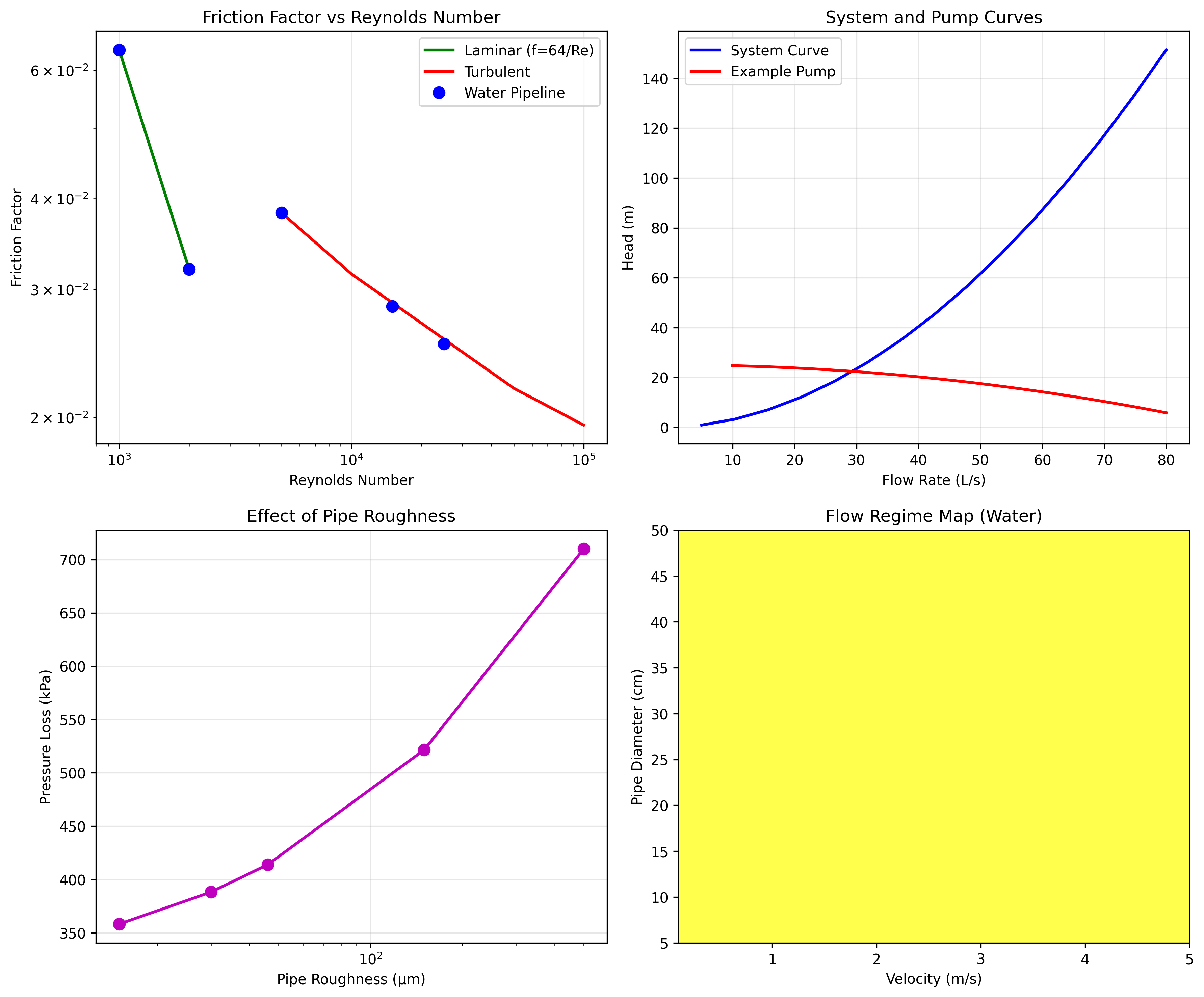
Visualization
The example generates comprehensive visualization plots showing:
Flow Rate vs Pressure Drop: Relationship between volumetric flow and pressure loss
Reynolds Number Analysis: Flow regime identification and transition points
Temperature Response: Thermal dynamics and heat transfer effects
Pipeline Profile: Pressure distribution along pipeline length
Design Charts: Engineering design and selection guidelines
Technical References
Moody, L.F. (1944). “Friction factors for pipe flow.” Transactions of the ASME, 66(8), 671-684.
Colebrook, C.F. (1939). “Turbulent flow in pipes.” Journal of the Institution of Civil Engineers, 11(4), 133-156.
White, F.M. (2011). Fluid Mechanics, 7th Edition. McGraw-Hill Education.
Crane Co. (2013). Flow of Fluids Through Valves, Fittings, and Pipe. Technical Paper No. 410.
See Also
PeristalticFlow Class - Positive displacement pump modeling
SlurryPipeline Class - Multiphase slurry transport
steady_state Function - Steady-state analysis functions
dynamics Function - Dynamic modeling functions