Fluidized Bed Reactor
Overview
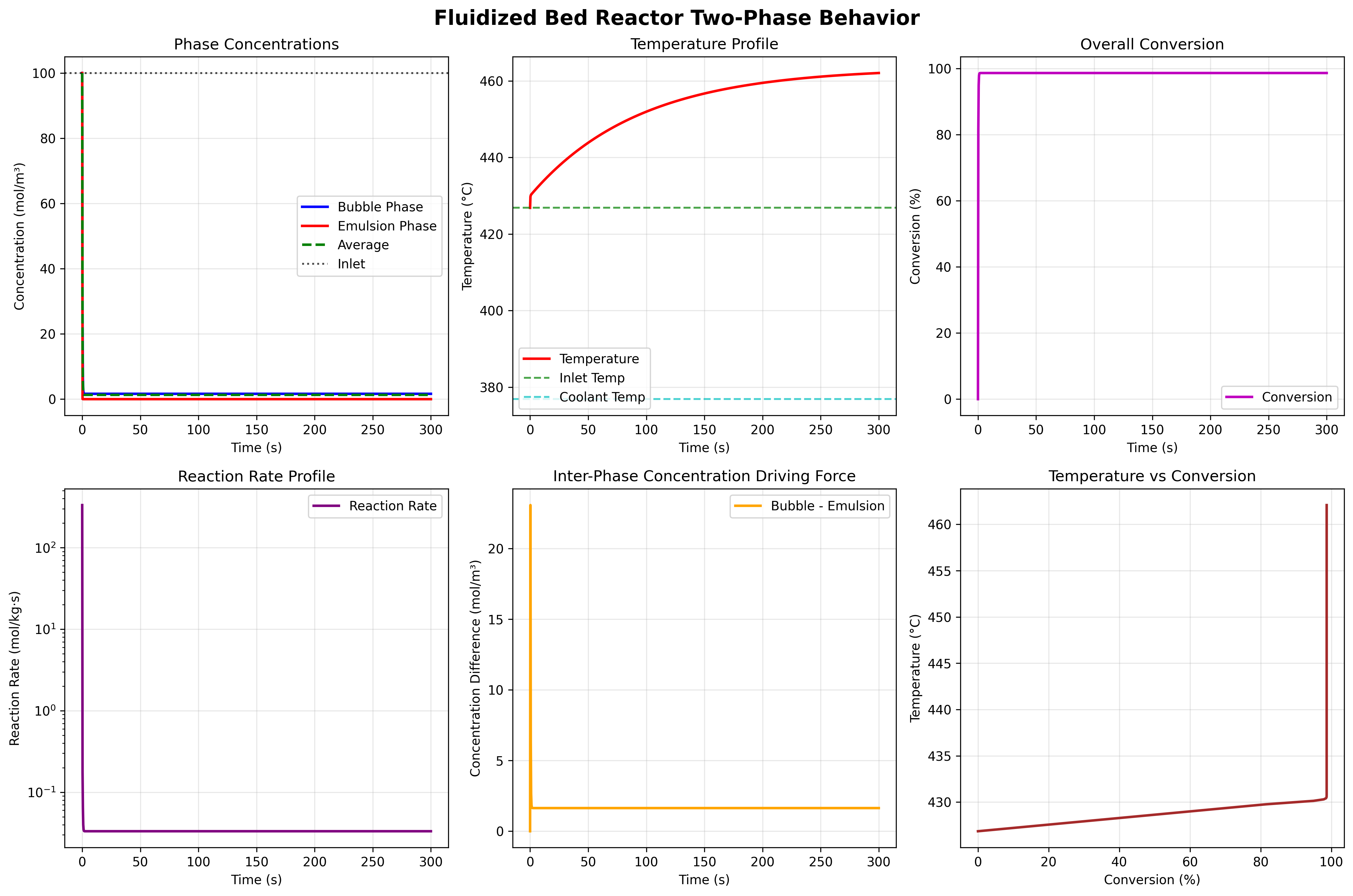
The Fluidized Bed Reactor model simulates two-phase fluidized systems with bubble and emulsion phases. It is used for catalytic cracking, combustion, and polymerization processes where excellent heat and mass transfer characteristics are required.
Theory and Equations
Two-Phase Model
Bubble Phase:
Emulsion Phase:
Fluidization Properties
Minimum fluidization velocity: \(U_{mf}\)
Bubble velocity: \(u_b = u_g - U_{mf} + u_{br}\)
Bubble fraction: \(\delta_b = f(u_g, U_{mf}, geometry)\)
Key Features
Two-phase (bubble and emulsion) modeling
Fluidization regime characterization
Heat and mass transfer between phases
Catalyst circulation effects
Gas-solid contact modeling
Usage Example
from unit.reactor.FluidizedBedReactor import FluidizedBedReactor

# Create Fluidized Bed Reactor instance
reactor = FluidizedBedReactor(
    H=3.0,               # Bed height [m]
    D=2.0,               # Bed diameter [m]
    U_mf=0.1,           # Minimum fluidization velocity [m/s]
    rho_cat=1500.0      # Catalyst density [kg/m³]
)
Example Output
Fluidized Bed Reactor Example
==================================================
Reactor: Fluidized Bed Reactor
Bed Height: 3.0 m
Bed Diameter: 2.0 m
Minimum Fluidization Velocity: 0.1 m/s
Catalyst Density: 1500.0 kg/m³
Particle Diameter: 0.50 mm
Activation Energy: 60.0 kJ/mol

Operating Conditions:
Inlet concentration: 100.0 mol/m³
Inlet temperature: 700.0 K (426.9 °C)
Superficial gas velocity: 0.3 m/s
Coolant temperature: 650.0 K (376.9 °C)

Reactor is fluidized (U_g > U_mf)
Excess velocity: 0.200 m/s

Fluidization Properties:
Bubble velocity: 0.250 m/s
Bubble fraction: 0.801
Emulsion fraction: 0.199
Performance Plots
Dynamic Response (fluidized_bed_reactor_example_plots.png)
Applications
Fluid catalytic cracking (FCC)
Coal combustion and gasification
Polymerization processes
Roasting and calcination
Waste treatment
See Also
Fixed Bed Reactor - Fixed bed reactor
Continuous Stirred Tank Reactor (CSTR) - Continuous stirred tank reactor