Plug Flow Reactor (PFR)
Overview
The Plug Flow Reactor (PFR) model simulates tubular reactors with axial discretization where fluid elements move through the reactor as “plugs” without back-mixing. It is widely used for gas-phase reactions, high-temperature processes, and situations where high conversion and precise residence time control are required.
Theory and Equations
Material Balance (per segment)
Energy Balance (per segment)
where: - \(u\) = superficial velocity [m/s] - \(z\) = axial position [m] - \(T_w\) = wall temperature [K] - \(V_{seg}\) = segment volume [m³]
Reaction Kinetics
Axial Discretization
The reactor is divided into n_segments: - Segment length: \(\Delta z = L / n_{segments}\) - Segment volume: \(V_{seg} = A_{cross} \times \Delta z\)
Parameters
Design Parameters
L: Reactor length [m] (1-100 m)
A_cross: Cross-sectional area [m²] (0.01-10 m²)
D_tube: Tube diameter [m] (0.05-2.0 m)
n_segments: Number of discretization segments (10-200)
Usage Example
Basic Implementation
from unit.reactor.PlugFlowReactor import PlugFlowReactor
import numpy as np

# Create PFR instance
reactor = PlugFlowReactor(
    L=10.0,                # Reactor length [m]
    A_cross=0.1,           # Cross-sectional area [m²]
    n_segments=20,         # Number of segments
    k0=1e8,                # Pre-exponential factor [1/min]
    Ea=60000.0             # Activation energy [J/mol]
)

# Operating conditions
u = np.array([50.0, 2.0, 400.0, 380.0])  # [q, CAi, Ti, Tw]

# Calculate steady-state profiles
x_ss = reactor.steady_state(u)
conversion = reactor.calculate_conversion(x_ss)
Example Output
Running the complete example produces:
============================================================
PlugFlowReactor (PFR) Example
============================================================
Reactor: Example_PFR
Length: 10.0 m
Cross-sectional area: 0.1 m²
Number of segments: 20
Segment length: 0.500 m

Steady-State Analysis:
------------------------------
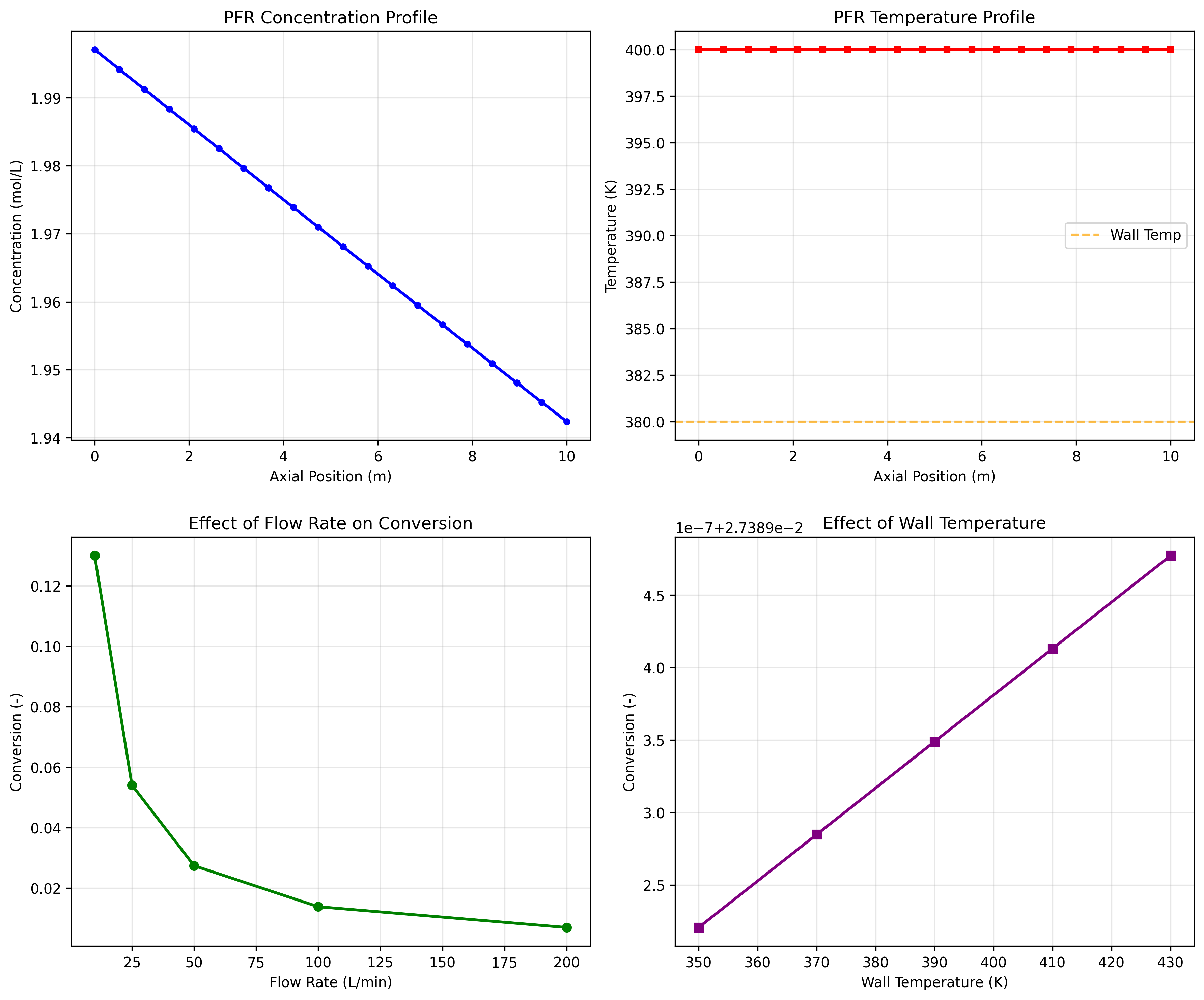
Overall conversion: 2.7%
Inlet concentration: 1.997 mol/L
Outlet concentration: 1.942 mol/L
Residence time: 0.02 min
Superficial velocity: 0.0083 m/s

Parametric Study - Flow Rate Effect:
----------------------------------------
Flow rate:   10.0 L/min → Conversion: 13.0%
Flow rate:   50.0 L/min → Conversion: 2.7%
Flow rate:  200.0 L/min → Conversion: 0.7%
Performance Plots
Axial Profiles (plug_flow_reactor_example_plots.png)
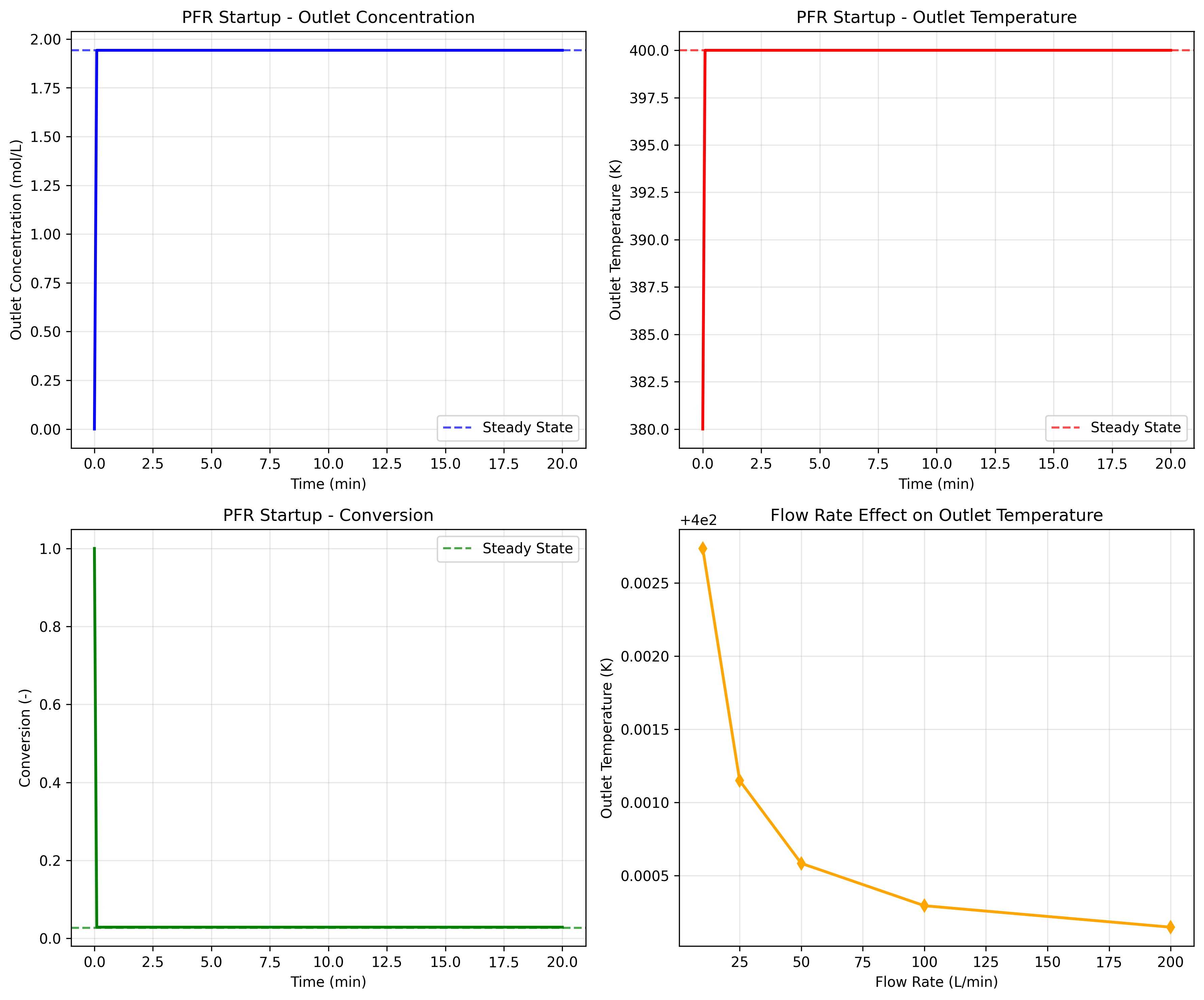
Dynamic Response (plug_flow_reactor_detailed_analysis.png)
Applications
Tubular reactors in petrochemical industry
Gas-phase high-temperature reactions
Steam cracking and reforming
Catalytic processes in tubes
Continuous polymerization
Example Output
Running the complete example produces the following results:
============================================================
PlugFlowReactor (PFR) Example
============================================================
Reactor: Example_PFR
Length: 10.0 m
Cross-sectional area: 0.1 m²
Number of segments: 20
Segment length: 0.500 m

Operating Conditions:
  q: 50.0 L/min
  CAi: 2.0 mol/L
  Ti: 400.0 K
  Tw: 380.0 K

Steady-State Analysis:
------------------------------
Overall conversion: 2.7%
Inlet concentration: 1.997 mol/L
Outlet concentration: 1.942 mol/L
Inlet temperature: 400.0 K
Outlet temperature: 400.0 K
Maximum temperature: 400.0 K
Residence time: 0.02 min
Superficial velocity: 0.0083 m/s
Performance Plots
The example generates visualization files:
Axial Profiles (plug_flow_reactor_example_plots.png)
Shows concentration and temperature evolution along reactor length.
Detailed Analysis (plug_flow_reactor_detailed_analysis.png)
Shows parametric studies of flow rate and wall temperature effects.
Limitations
No radial mixing assumed
Single reaction kinetics
Constant physical properties
Steady axial flow assumption
Literature References
Fogler, H.S. (2016). Elements of Chemical Reaction Engineering, 5th Edition, Prentice Hall.
Levenspiel, O. (1999). Chemical Reaction Engineering, 3rd Edition, John Wiley & Sons.
Froment, G.F., Bischoff, K.B., and De Wilde, J. (2010). Chemical Reactor Analysis and Design, 3rd Edition, John Wiley & Sons.
See Also
Continuous Stirred Tank Reactor (CSTR) - Continuous stirred tank reactor
Fixed Bed Reactor - Fixed bed catalytic reactor