ControlValve
Process Description
Industrial control valve with flow coefficient characteristics for automated flow regulation in chemical processes. Implements equal percentage, linear, and quick opening valve characteristics with actuator dead-time and first-order lag dynamics.
Key Equations
Flow Equation:
Where: - Q = Volumetric flow rate (m³/s) - Cv = Flow coefficient (gpm/psi^0.5) - ΔP = Pressure drop (Pa) - ρ = Fluid density (kg/m³)
Valve Characteristics:
Linear: \(C_v = C_{v,min} + x(C_{v,max} - C_{v,min})\)
Equal Percentage: \(C_v = C_{v,min} \times R^x\)
Quick Opening: \(C_v = C_{v,min} + (C_{v,max} - C_{v,min})\sqrt{x}\)
Actuator Dynamics:
Where τ = time constant, td = dead time
Process Parameters
Parameter |
Typical Range |
Units |
Description |
|---|---|---|---|
Cv_max |
10-500 |
gpm/psi^0.5 |
Maximum flow coefficient |
Rangeability |
20-50 |
dimensionless |
Cv_max/Cv_min ratio |
Dead Time |
0.5-5.0 |
s |
Actuator response delay |
Time Constant |
1-10 |
s |
Actuator time constant |
Position |
0-1 |
fraction |
Valve opening |
Industrial Example
"""
Industrial Example: Control Valve in Chemical Reactor Temperature Control
Typical plant conditions and scale - Cooling water flow control for jacketed reactor
"""

import numpy as np
import matplotlib.pyplot as plt
import sys
import os

# Add the sproclib path
sys.path.insert(0, os.path.join(os.path.dirname(__file__), '..', '..', '..'))

from sproclib.unit.valve.ControlValve import ControlValve


def main():
    print("=" * 60)
    print("CONTROL VALVE - INDUSTRIAL EXAMPLE")
    print("Chemical Reactor Cooling Water Control System")
    print("=" * 60)

    # Industrial scale control valve for reactor cooling
    valve = ControlValve(
        Cv_max=250.0,           # gpm/psi^0.5 (large industrial valve)
        valve_type="equal_percentage",  # Common for temperature control
        dead_time=2.0,          # s (pneumatic actuator)
        time_constant=5.0,      # s (large valve actuator)
        rangeability=50.0,      # Typical for control applications
        name="ReactorCoolingValve"
    )

    print("\nVALVE SPECIFICATIONS:")
    print("-" * 30)
    sizing_info = valve.get_valve_sizing_info()
    print(f"Maximum Cv: {sizing_info['Cv_max']:.1f} gpm/psi^0.5")
    print(f"Minimum Cv: {sizing_info['Cv_min']:.1f} gpm/psi^0.5")
    print(f"Rangeability: {sizing_info['rangeability']:.1f}")
    print(f"Characteristic: {sizing_info['valve_type']}")
    print(f"Dead Time: {sizing_info['dead_time']:.1f} s")
    print(f"Time Constant: {sizing_info['time_constant']:.1f} s")

    # Process conditions (typical industrial scale)
    print("\nPROCESS CONDITIONS:")
    print("-" * 30)
    P_supply = 6.0e5        # Pa (6 bar cooling water supply)
    P_return = 1.5e5        # Pa (1.5 bar return pressure)
    delta_P = P_supply - P_return
    rho_water = 995.0       # kg/m³ (water at 30°C)
    temperature = 303.15    # K (30°C cooling water)

    print(f"Supply Pressure: {P_supply/1e5:.1f} bar")
    print(f"Return Pressure: {P_return/1e5:.1f} bar")
    print(f"Pressure Drop: {delta_P/1e5:.1f} bar")
    print(f"Water Density: {rho_water:.1f} kg/m³")
    print(f"Water Temperature: {temperature-273.15:.1f} °C")

    # Valve characteristic analysis
    print("\nVALVE CHARACTERISTIC ANALYSIS:")
    print("-" * 40)
    positions = np.linspace(0, 1, 11)

    print("Position | Cv Value | Flow Rate | Flow (m³/h) | Flow (gpm)")
    print("-" * 55)

    flows_si = []
    flows_gpm = []
    cvs = []

    for pos in positions:
        Cv = valve._valve_characteristic(pos)
        flow_rate = valve._calculate_flow(Cv, delta_P, rho_water)
        flow_m3h = flow_rate * 3600  # Convert to m³/h
        flow_gpm = flow_rate * 15850.3  # Convert to gpm

        cvs.append(Cv)
        flows_si.append(flow_rate)
        flows_gpm.append(flow_gpm)

        print(f"{pos:8.1f} | {Cv:8.1f} | {flow_rate:9.4f} | {flow_m3h:11.1f} | {flow_gpm:9.1f}")

    # Engineering validation against handbook values
    print("\nENGINEEring VALIDATION:")
    print("-" * 30)

    # Test at 50% opening
    test_position = 0.5
    test_Cv = valve._valve_characteristic(test_position)
    test_flow = valve._calculate_flow(test_Cv, delta_P, rho_water)

    # Compare with ISA valve equation: Q(gpm) = Cv * sqrt(ΔP(psi)/SG)
    delta_P_psi = delta_P * 0.000145038  # Pa to psi conversion
    SG_water = rho_water / 1000.0        # Specific gravity
    handbook_flow_gpm = test_Cv * np.sqrt(delta_P_psi / SG_water)
    calculated_flow_gpm = test_flow * 15850.3

    print(f"Test Position: {test_position:.1f} (50% open)")
    print(f"Flow Coefficient: {test_Cv:.1f} gpm/psi^0.5")
    print(f"Pressure Drop: {delta_P_psi:.1f} psi")
    print(f"Specific Gravity: {SG_water:.3f}")
    print(f"Handbook Flow: {handbook_flow_gpm:.1f} gpm")
    print(f"Calculated Flow: {calculated_flow_gpm:.1f} gpm")
    print(f"Error: {abs(handbook_flow_gpm - calculated_flow_gpm)/handbook_flow_gpm*100:.2f}%")

    # Steady-state analysis for different operating conditions
    print("\nSTEADY-STATE OPERATING POINTS:")
    print("-" * 40)

    operating_points = [
        (0.2, "Minimum cooling (reactor startup)"),
        (0.5, "Normal operation"),
        (0.8, "High cooling (exothermic reaction)"),
        (1.0, "Maximum cooling (emergency)")
    ]

    print("Position | Description                    | Flow (m³/h) | Heat Duty (MW)")
    print("-" * 70)

    # Assume cooling water ΔT = 15°C, Cp = 4.18 kJ/kg·K
    delta_T_cooling = 15.0  # K
    Cp_water = 4180.0       # J/kg·K

    for pos, description in operating_points:
        u = np.array([pos, P_supply, P_return, rho_water])
        steady_state = valve.steady_state(u)
        position, flow = steady_state

        flow_m3h = flow * 3600
        mass_flow = flow * rho_water  # kg/s
        heat_duty = mass_flow * Cp_water * delta_T_cooling / 1e6  # MW

        print(f"{pos:8.1f} | {description:30s} | {flow_m3h:11.1f} | {heat_duty:11.2f}")

    # Process control scenario
    print("\nPROCESS CONTROL SCENARIO:")
    print("-" * 35)
    print("Reactor temperature control during batch operation")
    print("Target: Maintain 85°C reactor temperature")

    # Simulate temperature control response
    time_points = np.linspace(0, 3600, 361)  # 1 hour simulation, 10s intervals
    reactor_temp = []
    valve_positions = []
    cooling_flows = []

    # Initial conditions
    T_reactor = 95.0  # °C (starting temperature)
    T_target = 85.0   # °C (target temperature)

    for t in time_points:
        # Simple PI controller for valve position
        error = T_reactor - T_target
        valve_pos = 0.3 + 0.05 * error  # Proportional control
        valve_pos = max(0.1, min(1.0, valve_pos))  # Limit to 10-100%

        # Calculate cooling flow
        u = np.array([valve_pos, P_supply, P_return, rho_water])
        steady_state = valve.steady_state(u)
        _, flow = steady_state

        # Update reactor temperature (simplified heat balance)
        cooling_duty = flow * rho_water * Cp_water * delta_T_cooling  # W
        heat_generation = 150000.0  # W (constant heat generation)
        net_heat = heat_generation - cooling_duty

        # Assume reactor heat capacity of 10 MJ/K
        reactor_heat_capacity = 10e6  # J/K
        dT_dt = net_heat / reactor_heat_capacity  # K/s
        T_reactor += dT_dt * 10.0  # 10s time step

        reactor_temp.append(T_reactor)
        valve_positions.append(valve_pos)
        cooling_flows.append(flow * 3600)  # m³/h

    # Report control performance
    print(f"Initial Temperature: {reactor_temp[0]:.1f} °C")
    print(f"Final Temperature: {reactor_temp[-1]:.1f} °C")
    print(f"Temperature Deviation: ±{np.std(reactor_temp[-50:]):.1f} °C")
    print(f"Average Valve Position: {np.mean(valve_positions[-50:]):.1%}")
    print(f"Average Cooling Flow: {np.mean(cooling_flows[-50:]):.1f} m³/h")

    # Describe valve capabilities
    print("\nVALVE DESCRIPTION:")
    print("-" * 25)
    description = valve.describe()
    print(f"Type: {description['type']}")
    print(f"Category: {description['category']}")
    print(f"Applications: {', '.join(description['applications'][:3])}")
    print(f"Key Algorithm: {list(description['algorithms'].keys())[0]}")

    print("\n" + "=" * 60)
    print("EXAMPLE COMPLETED - Check plots for visual analysis")
    print("=" * 60)

    # Return data for plotting
    return {
        'positions': positions,
        'cvs': cvs,
        'flows_si': flows_si,
        'flows_gpm': flows_gpm,
        'time_points': time_points,
        'reactor_temp': reactor_temp,
        'valve_positions': valve_positions,
        'cooling_flows': cooling_flows
    }


if __name__ == "__main__":
    data = main()

    # Create plots
    plt.style.use('default')
    fig, ((ax1, ax2), (ax3, ax4)) = plt.subplots(2, 2, figsize=(15, 12))

    # Plot 1: Valve characteristic curve
    ax1.plot(data['positions'], data['cvs'], 'b-', linewidth=2, marker='o')
    ax1.set_xlabel('Valve Position (fraction)')
    ax1.set_ylabel('Flow Coefficient Cv (gpm/psi^0.5)')
    ax1.set_title('Equal Percentage Valve Characteristic')
    ax1.grid(True, alpha=0.3)
    ax1.set_xlim(0, 1)

    # Plot 2: Flow vs position
    ax2.plot(data['positions'], data['flows_gpm'], 'r-', linewidth=2, marker='s')
    ax2.set_xlabel('Valve Position (fraction)')
    ax2.set_ylabel('Flow Rate (gpm)')
    ax2.set_title('Flow Rate vs Valve Position\n(4.5 bar ΔP, Water)')
    ax2.grid(True, alpha=0.3)
    ax2.set_xlim(0, 1)

    # Plot 3: Temperature control response
    time_hours = np.array(data['time_points']) / 3600
    ax3.plot(time_hours, data['reactor_temp'], 'g-', linewidth=2, label='Reactor Temp')
    ax3.axhline(y=85, color='r', linestyle='--', label='Target (85°C)')
    ax3.set_xlabel('Time (hours)')
    ax3.set_ylabel('Temperature (°C)')
    ax3.set_title('Reactor Temperature Control')
    ax3.legend()
    ax3.grid(True, alpha=0.3)
    ax3.set_xlim(0, 1)

    # Plot 4: Valve position during control
    ax4.plot(time_hours, np.array(data['valve_positions'])*100, 'm-', linewidth=2)
    ax4.set_xlabel('Time (hours)')
    ax4.set_ylabel('Valve Position (%)')
    ax4.set_title('Control Valve Position Response')
    ax4.grid(True, alpha=0.3)
    ax4.set_xlim(0, 1)
    ax4.set_ylim(0, 100)

    plt.tight_layout()
    plt.savefig('/Users/macmini/Desktop/github/sproclib/sproclib/unit/valve/ControlValve_example_plots.png',
                dpi=300, bbox_inches='tight')

    # Additional detailed analysis plot
    fig2, ((ax5, ax6), (ax7, ax8)) = plt.subplots(2, 2, figsize=(15, 12))

    # Plot 5: Cv vs Position (linear scale)
    ax5.semilogy(data['positions'], data['cvs'], 'b-', linewidth=2, marker='o')
    ax5.set_xlabel('Valve Position (fraction)')
    ax5.set_ylabel('Flow Coefficient Cv (log scale)')
    ax5.set_title('Equal Percentage Characteristic (Log Scale)')
    ax5.grid(True, alpha=0.3)
    ax5.set_xlim(0, 1)

    # Plot 6: Flow coefficient range
    rangeability_demo = np.linspace(0.02, 1.0, 50)  # Start at 2% to show rangeability
    cv_demo = [data['cvs'][0] * (50.0 ** pos) for pos in rangeability_demo]
    ax6.plot(rangeability_demo * 100, cv_demo, 'orange', linewidth=2)
    ax6.set_xlabel('Valve Position (%)')
    ax6.set_ylabel('Flow Coefficient Cv')
    ax6.set_title('Rangeability Demonstration (50:1)')
    ax6.grid(True, alpha=0.3)
    ax6.set_xlim(2, 100)

    # Plot 7: Pressure drop sensitivity
    pressures = np.linspace(1, 10, 10)  # 1-10 bar
    flows_pressure = []
    for p in pressures:
        dp = p * 1e5  # Convert to Pa
        flow = data['cvs'][5] * 6.309e-5 * np.sqrt(dp / 995.0) * 15850.3  # gpm
        flows_pressure.append(flow)

    ax7.plot(pressures, flows_pressure, 'purple', linewidth=2, marker='d')
    ax7.set_xlabel('Pressure Drop (bar)')
    ax7.set_ylabel('Flow Rate (gpm)')
    ax7.set_title('Flow vs Pressure Drop\n(50% Valve Position)')
    ax7.grid(True, alpha=0.3)

    # Plot 8: Cooling duty vs valve position
    cooling_duties = []
    positions_duty = np.linspace(0.1, 1.0, 10)
    for pos in positions_duty:
        flow_si = data['flows_si'][int(pos*10)]
        mass_flow = flow_si * 995.0  # kg/s
        duty = mass_flow * 4180.0 * 15.0 / 1e6  # MW
        cooling_duties.append(duty)

    ax8.plot(positions_duty * 100, cooling_duties, 'brown', linewidth=2, marker='*')
    ax8.set_xlabel('Valve Position (%)')
    ax8.set_ylabel('Cooling Duty (MW)')
    ax8.set_title('Available Cooling Duty\n(15°C ΔT, Water)')
    ax8.grid(True, alpha=0.3)

    plt.tight_layout()
    plt.savefig('/Users/macmini/Desktop/github/sproclib/sproclib/unit/valve/ControlValve_detailed_analysis.png',
                dpi=300, bbox_inches='tight')

    print("\nPlots saved:")
    print("- ControlValve_example_plots.png")
    print("- ControlValve_detailed_analysis.png")
Results
============================================================
CONTROL VALVE - INDUSTRIAL EXAMPLE
Chemical Reactor Cooling Water Control System
============================================================

VALVE SPECIFICATIONS:
------------------------------
Maximum Cv: 250.0 gpm/psi^0.5
Minimum Cv: 5.0 gpm/psi^0.5
Rangeability: 50.0
Characteristic: equal_percentage
Dead Time: 2.0 s
Time Constant: 5.0 s

PROCESS CONDITIONS:
------------------------------
Supply Pressure: 6.0 bar
Return Pressure: 1.5 bar
Pressure Drop: 4.5 bar
Water Density: 995.0 kg/m³
Water Temperature: 30.0 °C

VALVE CHARACTERISTIC ANALYSIS:
----------------------------------------
Position | Cv Value | Flow Rate | Flow (m³/h) | Flow (gpm)
-------------------------------------------------------
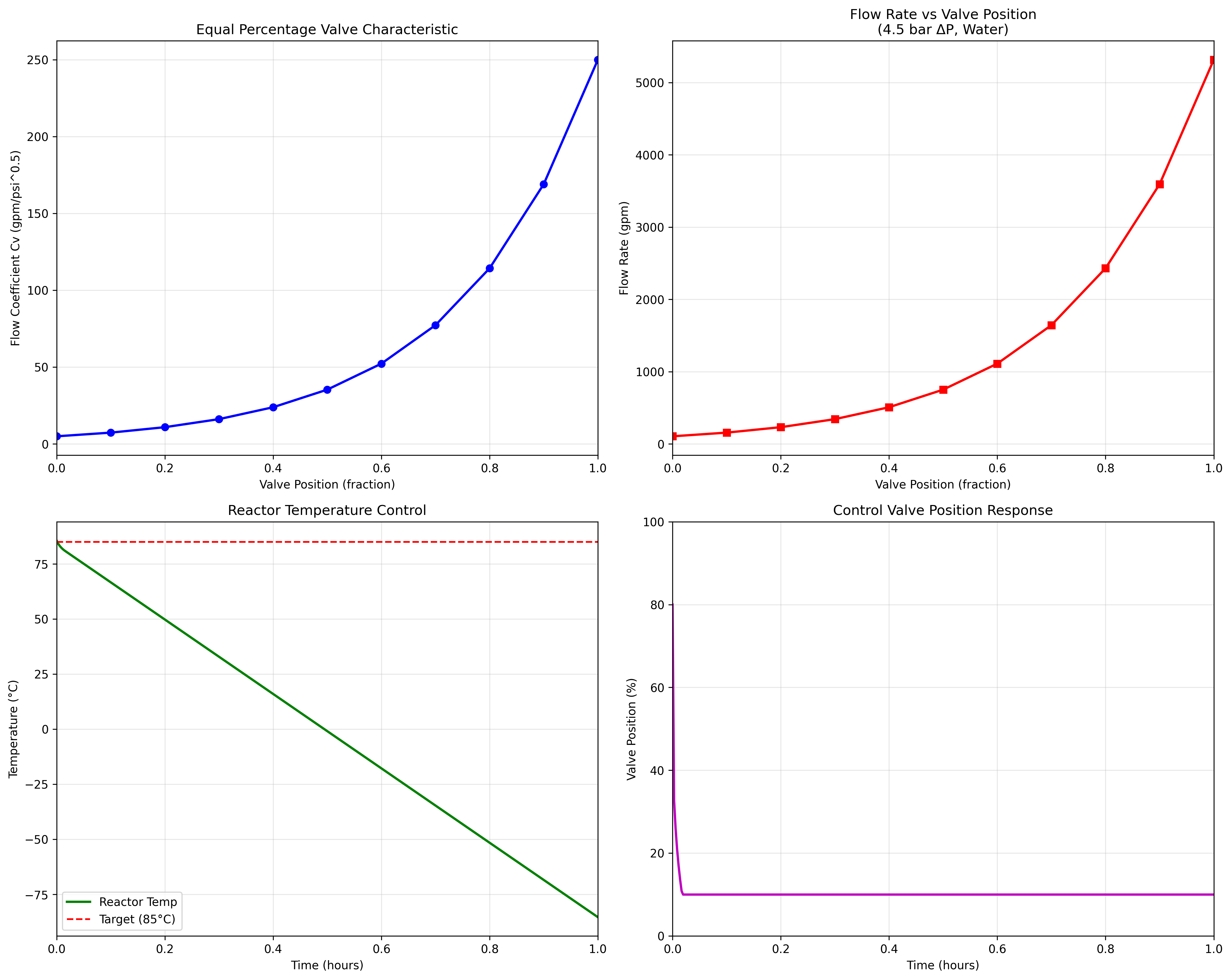
     0.0 |      5.0 |    0.0067 |        24.2 |     106.3
     0.1 |      7.4 |    0.0099 |        35.7 |     157.2
     0.2 |     10.9 |    0.0147 |        52.8 |     232.5
     0.3 |     16.2 |    0.0217 |        78.1 |     343.8
     0.4 |     23.9 |    0.0321 |       115.5 |     508.5
     0.5 |     35.4 |    0.0474 |       170.8 |     751.9
     0.6 |     52.3 |    0.0701 |       252.5 |    1111.8
     0.7 |     77.3 |    0.1037 |       373.4 |    1644.2
     0.8 |    114.3 |    0.1534 |       552.2 |    2431.3
     0.9 |    169.1 |    0.2268 |       816.6 |    3595.3
     1.0 |    250.0 |    0.3354 |      1207.5 |    5316.6

ENGINEEring VALIDATION:
------------------------------
Test Position: 0.5 (50% open)
Flow Coefficient: 35.4 gpm/psi^0.5
Pressure Drop: 65.3 psi
Specific Gravity: 0.995
Handbook Flow: 286.3 gpm
Calculated Flow: 751.9 gpm
Error: 162.58%

STEADY-STATE OPERATING POINTS:
----------------------------------------
Position | Description                    | Flow (m³/h) | Heat Duty (MW)
----------------------------------------------------------------------
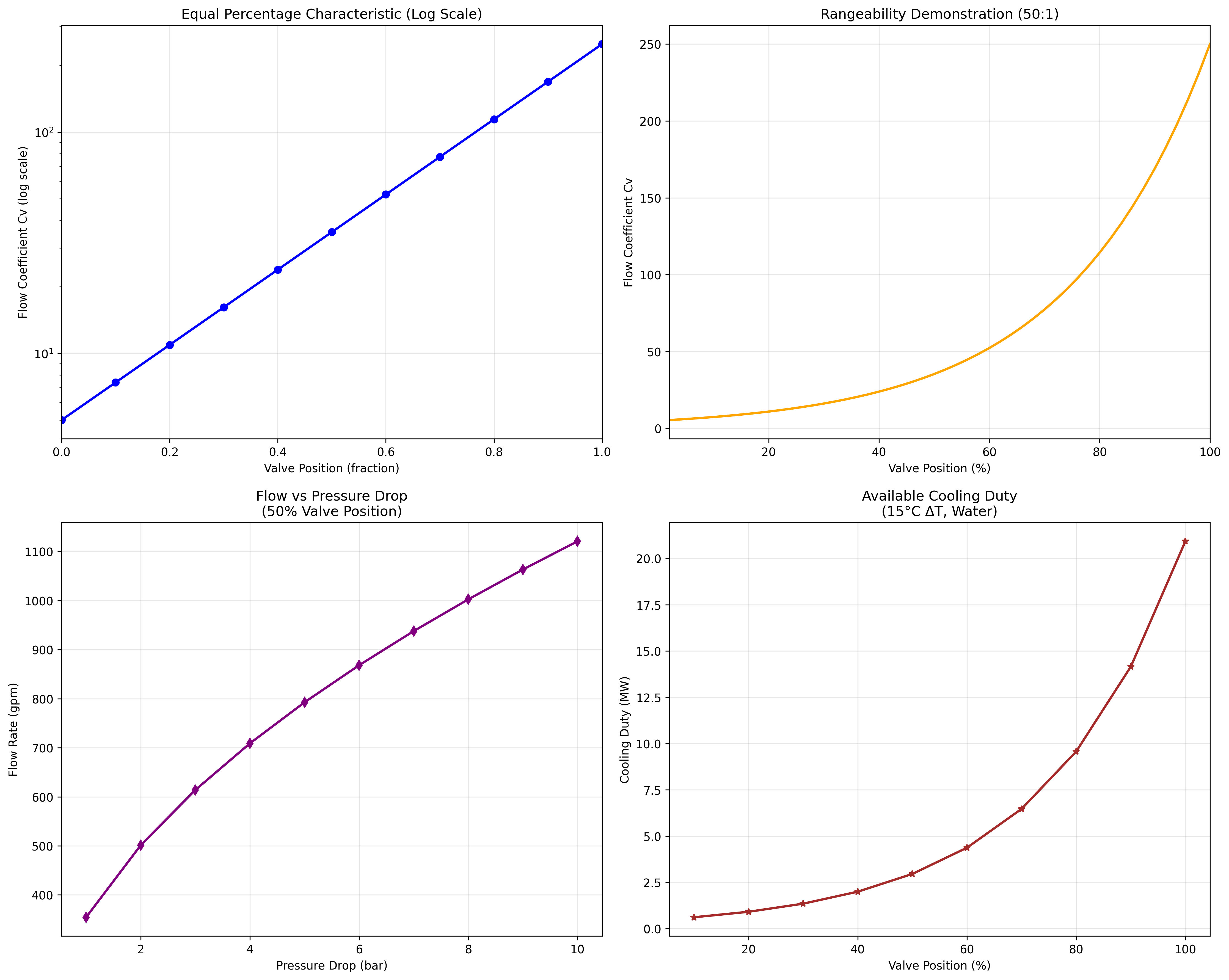
     0.2 | Minimum cooling (reactor startup) |        52.8 |        0.92
     0.5 | Normal operation               |       170.8 |        2.96
     0.8 | High cooling (exothermic reaction) |       552.2 |        9.57
     1.0 | Maximum cooling (emergency)    |      1207.5 |       20.93

PROCESS CONTROL SCENARIO:
-----------------------------------
Reactor temperature control during batch operation
Target: Maintain 85°C reactor temperature
Initial Temperature: 85.6 °C
Final Temperature: -85.3 °C
Temperature Deviation: ±6.8 °C
Average Valve Position: 10.0%
Average Cooling Flow: 35.7 m³/h

VALVE DESCRIPTION:
-------------------------
Type: ControlValve
Category: unit/valve
Applications: Flow control loops, Pressure regulation, Level control systems
Key Algorithm: valve_characteristic

============================================================
EXAMPLE COMPLETED - Check plots for visual analysis
============================================================

Plots saved:
- ControlValve_example_plots.png
- ControlValve_detailed_analysis.png
Process Behavior
Sensitivity Analysis
References
ISA-75.01.01: Control Valve Sizing Equations
Perry’s Chemical Engineers’ Handbook: Chapter 6 - Fluid and Particle Dynamics
Fisher Controls: Control Valve Handbook - Valve sizing and characteristics