Continuous Stirred Tank Reactor (CSTR)
Overview
The Continuous Stirred Tank Reactor (CSTR) model simulates a well-mixed reactor with continuous feed and discharge streams. The model incorporates Arrhenius reaction kinetics, material balance, energy balance, and heat transfer with jacket cooling. It is widely used in chemical process engineering for reactor design, control system development, and process optimization.
Theory and Equations
Material Balance
The material balance for a first-order reaction in a CSTR is:
where: - \(C_A\) = concentration in reactor [mol/L] - \(C_{A,i}\) = inlet concentration [mol/L] - \(q\) = volumetric flow rate [L/min] - \(V\) = reactor volume [L] - \(k(T)\) = temperature-dependent rate constant [1/min]
Energy Balance
The energy balance accounts for sensible heat, reaction heat, and jacket heat transfer:
where: - \(T\) = reactor temperature [K] - \(T_i\) = inlet temperature [K] - \(T_c\) = coolant temperature [K] - \(\Delta H_r\) = heat of reaction [J/mol] - \(\rho\) = density [g/L] - \(C_p\) = heat capacity [J/g/K] - \(UA\) = overall heat transfer coefficient [J/min/K]
Reaction Kinetics
The reaction rate follows the Arrhenius equation:
where: - \(k_0\) = pre-exponential factor [1/min] - \(E_a\) = activation energy [J/mol] - \(R\) = gas constant (8.314 J/mol/K)
Parameters
Design Parameters
V: Reactor volume [L]
Typical range: 10-10,000 L
Laboratory scale: 1-10 L
Industrial scale: 1,000-10,000 L
UA: Heat transfer coefficient [J/min/K]
Typical range: 1,000-100,000 J/min/K
Depends on jacket design and heat transfer area
Kinetic Parameters
k₀: Pre-exponential factor [1/min]
Typical range: 10⁶-10¹² 1/min
Reaction-specific parameter
Eₐ: Activation energy [J/mol]
Typical range: 40,000-100,000 J/mol
Higher values indicate stronger temperature dependence
Physical Properties
ρ: Density [g/L]
Typical range: 800-1,200 g/L
Temperature-dependent (assumed constant)
Cₚ: Heat capacity [J/g/K]
Typical range: 0.1-0.5 J/g/K
Composition and temperature dependent
ΔHᵣ: Heat of reaction [J/mol]
Exothermic reactions: negative values
Typical range: -100,000 to -10,000 J/mol
Operating Ranges
Safe Operating Window
Temperature Control:
Operating range: 250-600 K
Optimal range: 300-500 K
Safety limit: <600 K to prevent thermal runaway
Concentration Ranges:
Feed concentration: 0.1-10 mol/L
Target conversion: 10-95%
Maximum concentration: <100 mol/L
Flow Rate Ranges:
Minimum: 0.1 L/min (continuous operation)
Maximum: 1,000 L/min (mixing limitations)
Optimal: 1-100 L/min for most applications
Usage Example
Basic Implementation
from unit.reactor.cstr import CSTR
import numpy as np

# Create CSTR instance
reactor = CSTR(
    V=100.0,           # Reactor volume [L]
    k0=7.2e10,         # Pre-exponential factor [1/min]
    Ea=72750.0,        # Activation energy [J/mol]
    dHr=-50000.0,      # Heat of reaction [J/mol]
    UA=50000.0         # Heat transfer coefficient [J/min/K]
)

# Define operating conditions
u = np.array([10.0, 1.0, 350.0, 300.0])  # [q, CAi, Ti, Tc]

# Calculate steady state
x_ss = reactor.steady_state(u)
print(f"Steady-state concentration: {x_ss[0]:.4f} mol/L")
print(f"Steady-state temperature: {x_ss[1]:.2f} K")
Dynamic Simulation
from scipy.integrate import solve_ivp

# Initial conditions
x0 = np.array([1.0, 350.0])  # [CA0, T0]

# Time span
t_span = (0, 60)  # 0 to 60 minutes
t_eval = np.linspace(0, 60, 300)

# Solve ODE
def cstr_ode(t, x):
    return reactor.dynamics(t, x, u)

sol = solve_ivp(cstr_ode, t_span, x0, t_eval=t_eval, method='RK45')
Example Output
Running the complete example produces the following results:
============================================================
CSTR (Continuous Stirred Tank Reactor) Example
============================================================
Reactor: Example_CSTR
Volume: 100.0 L
Heat transfer coefficient: 50000.0 J/min/K

Operating Conditions:
  q: 10.0 L/min
  CAi: 1.0 mol/L
  Ti: 350.0 K
  Tc: 300.0 K

Steady State Analysis:
------------------------------
Steady-state concentration: 0.8140 mol/L
Steady-state temperature: 304.06 K
Conversion: 18.6%
Residence time: 10.00 min
Reaction rate constant: 2.29e-02 1/min
Heat generation: 93014 J/min
Productivity: 8.140 mol/min

Dynamic Simulation:
------------------------------
Dynamic simulation completed successfully
Final concentration: 0.8135 mol/L
Final temperature: 304.06 K
Final conversion: 18.6%
Time to 95% of steady state: 24.7 min

Step Response Analysis:
------------------------------
Temperature change after step: -66.54 K
Concentration change after step: -0.0276 mol/L
Performance Plots
The example generates two visualization files:
Dynamic Response (cstr_example_plots.png)
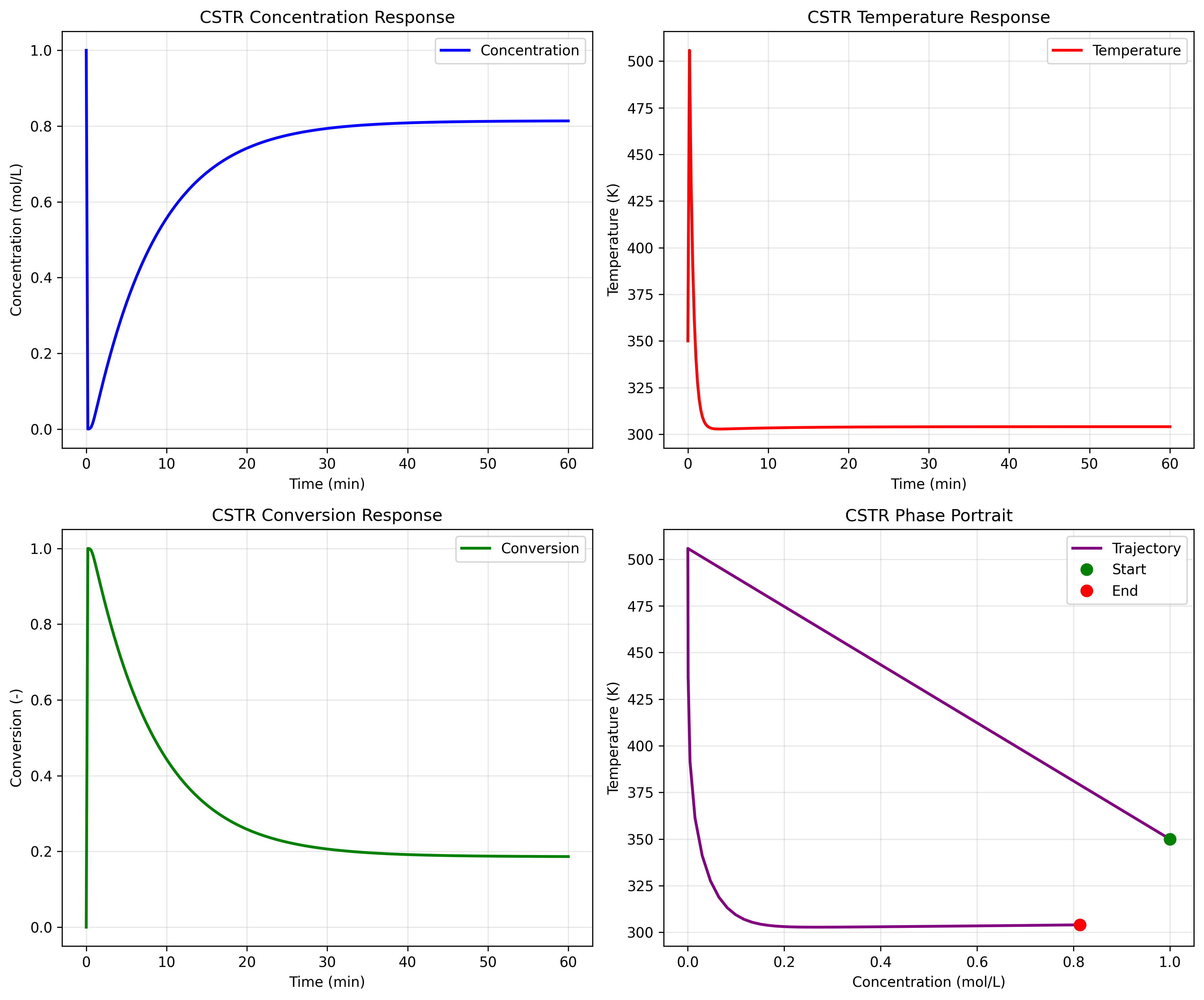
Shows concentration, temperature, conversion, and phase portrait during startup.
Step Response Analysis (cstr_detailed_analysis.png)
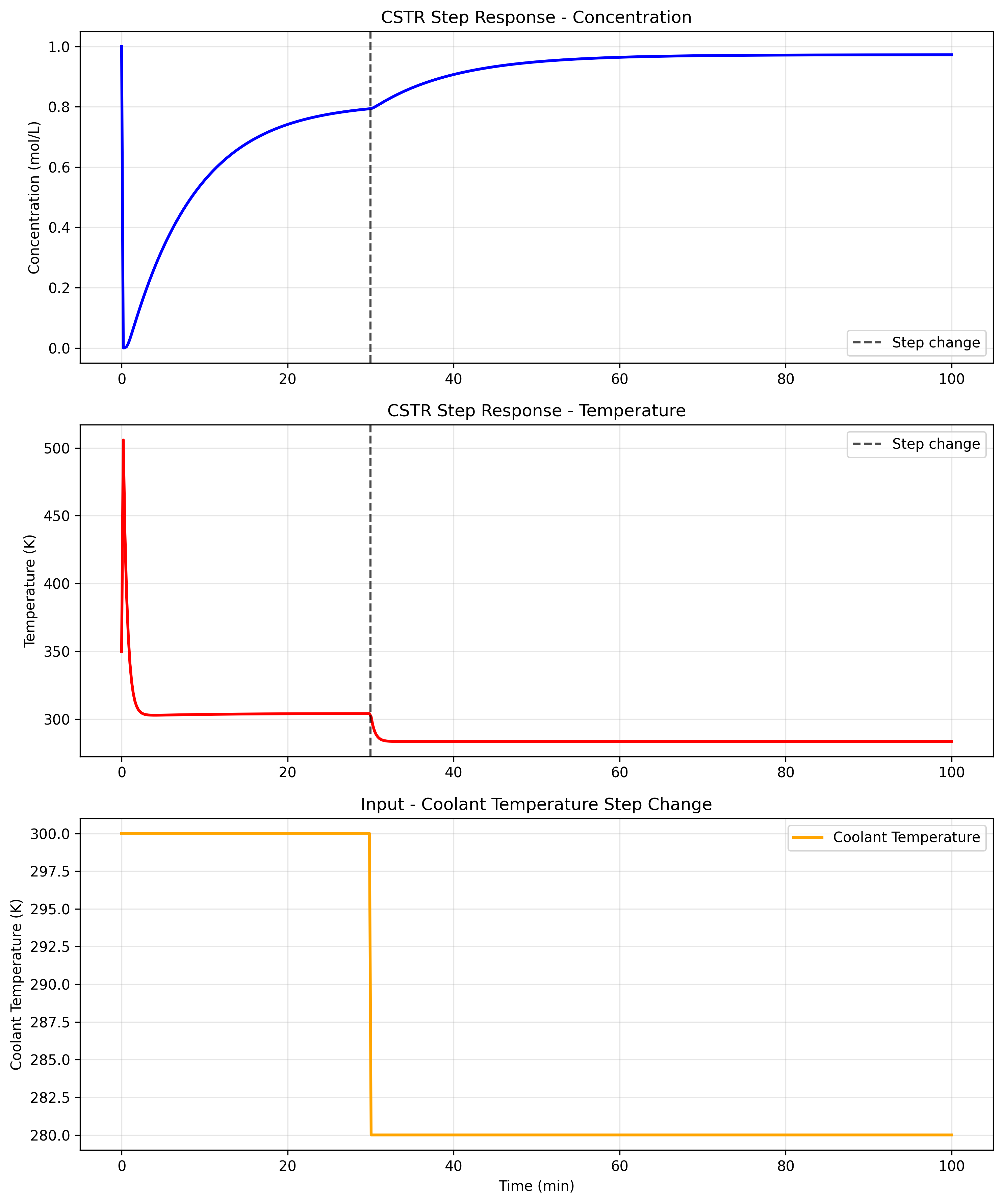
Shows reactor response to coolant temperature step change.
Applications
The CSTR model is applicable for:
Process Design: Reactor sizing and configuration
Control System Design: Controller tuning and testing
Process Optimization: Operating condition optimization
Safety Analysis: Thermal runaway and stability analysis
Educational Purposes: Teaching reaction engineering concepts
Limitations
Model assumptions and limitations:
Perfect Mixing: Assumes instantaneous mixing throughout reactor
Single Reaction: Limited to first-order reaction kinetics
Constant Properties: Physical properties assumed temperature-independent
No Mass Transfer: Ignores mass transfer limitations
Ideal Behavior: No catalyst deactivation or side reactions
Literature References
Fogler, H.S. (2016). Elements of Chemical Reaction Engineering, 5th Edition, Prentice Hall.
Levenspiel, O. (1999). Chemical Reaction Engineering, 3rd Edition, John Wiley & Sons.
Rawlings, J.B. and Ekerdt, J.G. (2002). Chemical Reactor Analysis and Design Fundamentals, Nob Hill Publishing.
Schmidt, L.D. (2005). The Engineering of Chemical Reactions, 2nd Edition, Oxford University Press.
Davis, M.E. and Davis, R.J. (2003). Fundamentals of Chemical Reaction Engineering, McGraw-Hill.
See Also
Batch Reactor - Batch reactor model
Plug Flow Reactor (PFR) - Plug flow reactor model
Fixed Bed Reactor - Fixed bed catalytic reactor model