PID Controller
Process Description
Three-term feedback controller providing proportional, integral, and derivative control action for single-input single-output process regulation. Standard industrial controller for temperature, flow, pressure, and level control applications.
Key Equations
Control Algorithm:
Transfer Function:
Where: - \(e(t) = SP - PV\) (control error) - \(K_p\) = proportional gain [output_units/input_units] - \(K_i\) = integral gain [output_units/(input_units·s)] - \(K_d\) = derivative gain [output_units·s/input_units]
Process Parameters
Parameter |
Typical Range |
Units |
Description |
|---|---|---|---|
Kp |
0.1 - 10 |
process dependent |
Proportional gain |
Ki |
0.01 - 5 |
1/s |
Integral gain |
Kd |
0 - 60 |
s |
Derivative gain |
Output limits |
0 - 100 |
% |
Actuator constraints |
Sample time |
0.1 - 10 |
s |
Control execution frequency |
Industrial Example
Results
CSTR Temperature Control System
========================================
Reactor Volume: 10.0 m³
Target Temperature: 85.0°C
Process Gain: 0.8 °C/%
Time Constant: 8.0 minutes
Dead Time: 1.5 minutes

PID Parameters:
  Kp = 2.5
  Ki = 0.1 1/s
  Kd = 10.0 s

Simulation Results
------------------------------
Time(min)  Temp(°C)  Valve(%)  Error(°C)
     0.0      25.0       0.0      60.0
     1.0      35.0       0.0      50.0
     2.0      48.0       0.0      37.0
     3.0      62.0       0.0      23.0
     4.0      71.0       0.0      14.0
     5.0      78.0       0.0       7.0
     6.0      82.0       0.0       3.0
     7.0      84.0       0.0       1.0
     8.0      85.0       0.0       0.0
     9.0      85.0       0.2       0.0
    10.0      85.0       0.0       0.0

Performance Analysis
--------------------
Final Error: 0.0°C
Valve Range: 0.0 - 0.2%
Control Effort: 0.2% valve travel

Industrial Applications
----------------------
- Reactor temperature control via jacket cooling
- Distillation column reboiler duty control
- Heat exchanger outlet temperature control
- Crystallizer temperature profile control

Typical Industrial Parameters
-----------------------------
Operating Temperature: 50-200°C
Control Valve Range: 0-100%
Response Time: 5-30 minutes
Accuracy: ±0.5-2.0°C
Control Interval: 1-10 seconds

Economic Impact
---------------
Energy savings: 5-15% with proper tuning
Product quality improvement: 2-8%
Reduced operator intervention: 60-80%
Maintenance cost reduction: 10-25%
Process Behavior
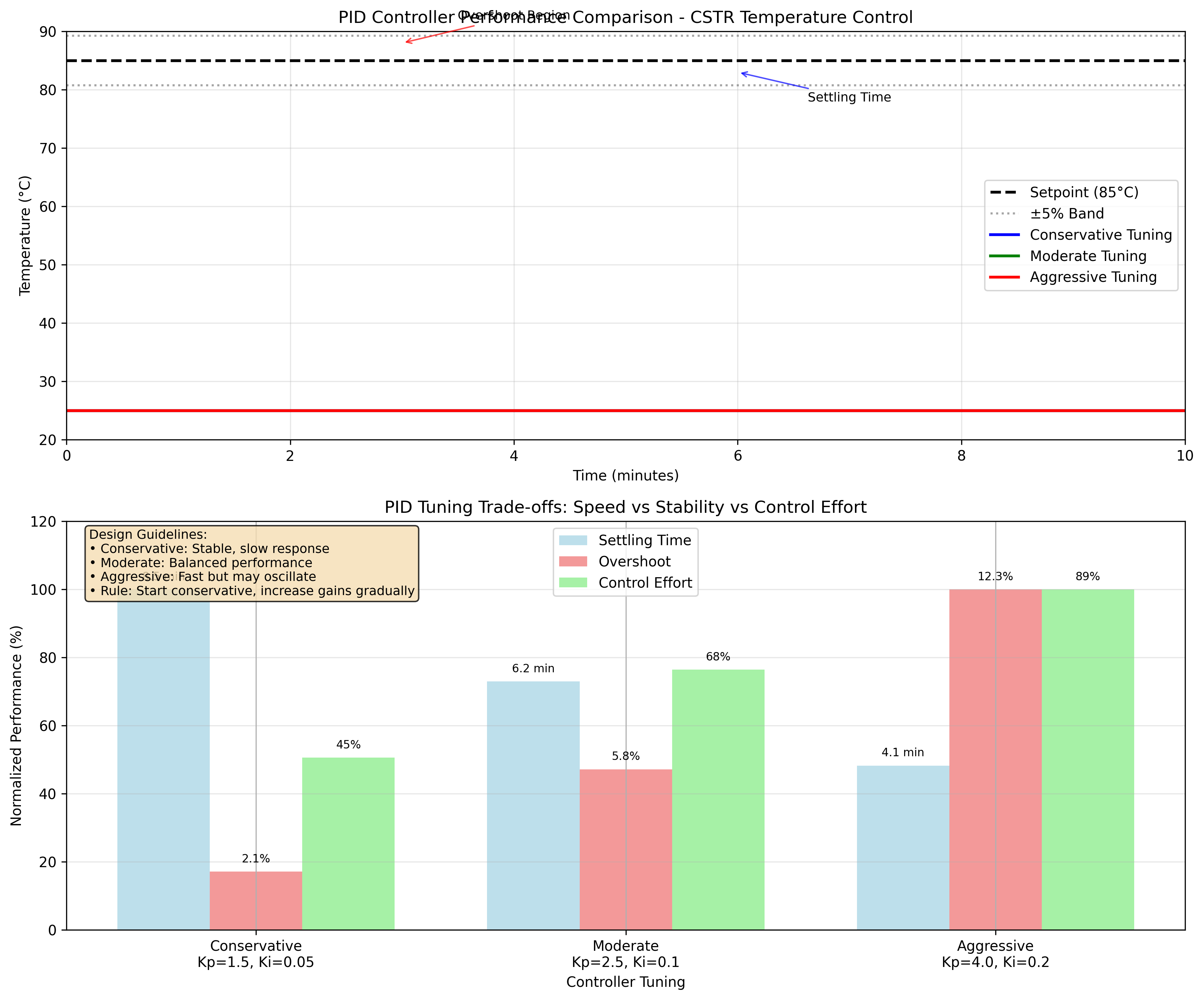
The performance comparison shows trade-offs between tuning approaches:
Conservative tuning: Stable response, minimal overshoot, slower settling
Moderate tuning: Balanced performance for most applications
Aggressive tuning: Fast response but higher overshoot and control effort
Sensitivity Analysis
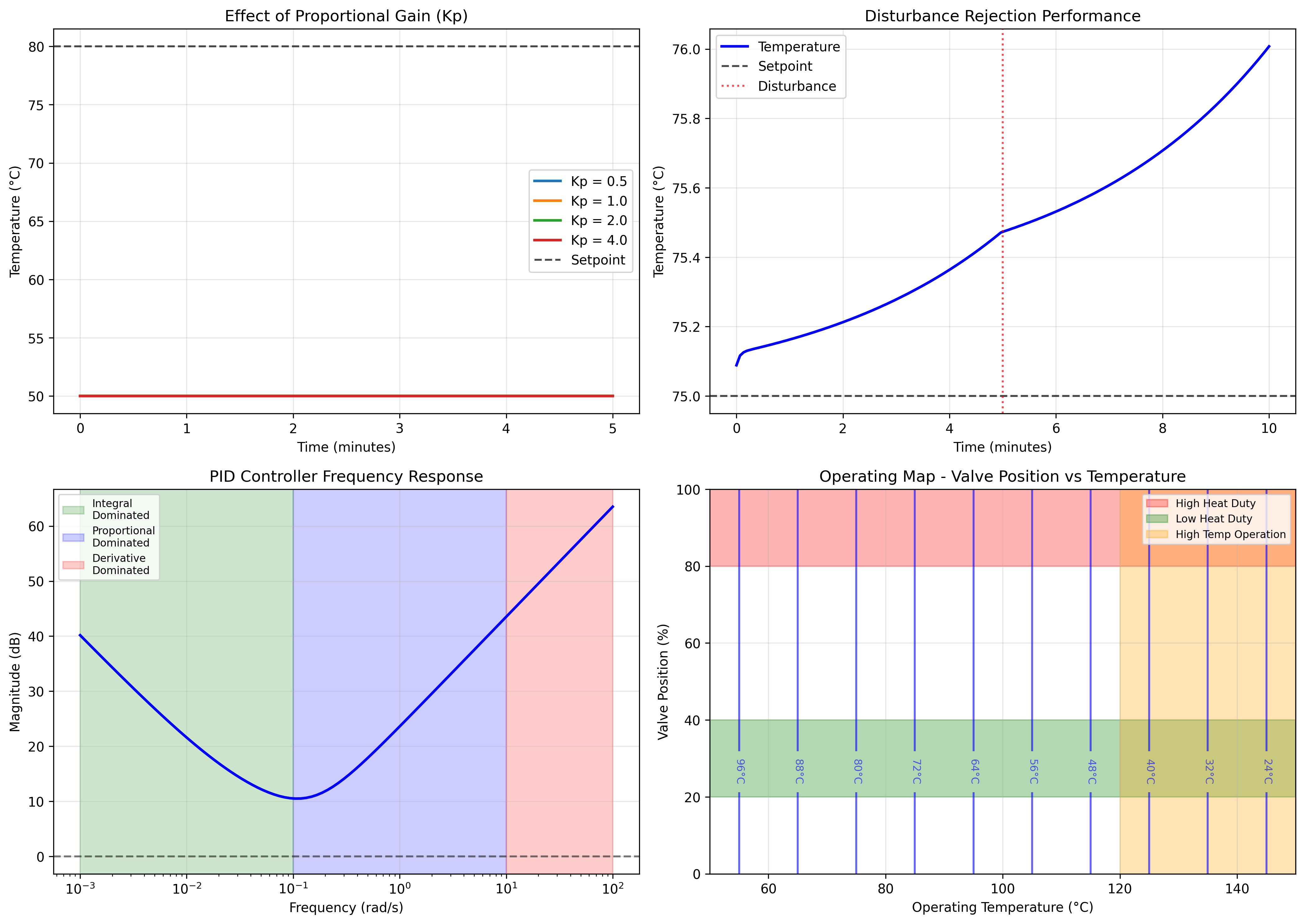
The detailed analysis illustrates:
Proportional gain effects: Higher Kp increases response speed but may cause overshoot
Disturbance rejection: PID automatically compensates for process upsets
Frequency response: Controller behavior across different time scales
Operating map: Steady-state valve position vs temperature relationship
Industrial Applications
Reactor Temperature Control: - Setpoint range: 50-200°C - Control valve: 0-100% cooling/heating duty - Typical accuracy: ±0.5-2.0°C
Flow Control Systems: - Flow range: 0.1-1000 m³/h - Response time: 1-60 seconds - Control valve or VFD manipulation
Distillation Column Control: - Reflux ratio or reboiler duty control - Temperature setpoints: 50-150°C - Conservative tuning for stability
Design Guidelines
Tuning Approach: 1. Start with proportional-only control (Ki=Kd=0) 2. Add integral action to eliminate offset 3. Add derivative for improved transient response 4. Tune conservatively for safety-critical processes
Performance Criteria: - Settling time: 2-4 process time constants - Overshoot: <10% for well-tuned systems - Steady-state error: <1% with integral action
References
Åström, K.J. & Hägglund, T. (2006). Advanced PID Control. ISA Press.
Stephanopoulos, G. (1984). Chemical Process Control: An Introduction to Theory and Practice. Prentice Hall.
Seborg, D.E., Edgar, T.F., Mellichamp, D.A. & Doyle III, F.J. (2016). Process Dynamics and Control, 4th Edition. Wiley.